Marc Chagall
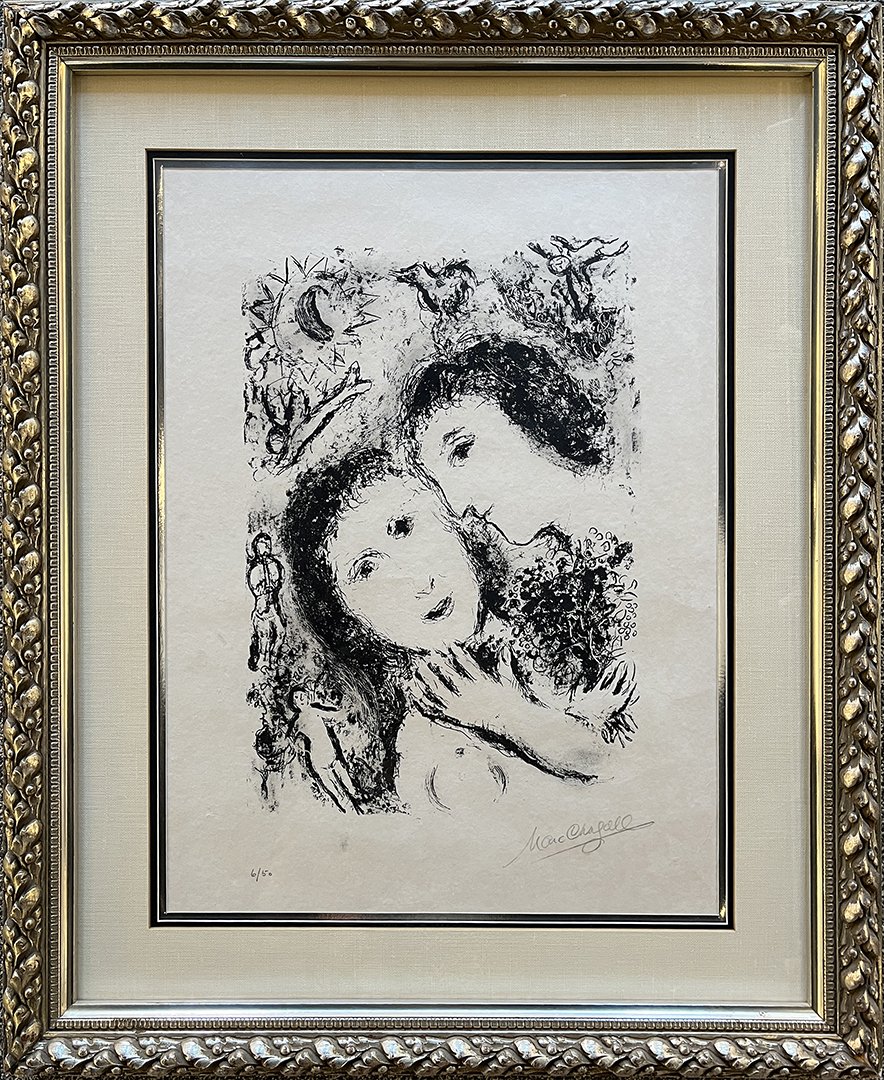
Marc Chagall
Jacob and Rachel
Lithograph on Japon Paper, ed. 6/50
24 x 17 1/2 inches
Signed Lower Right
ID: DH4823
Marc Chagall was born on July 7, 1887, in Vitebsk, Russia. From 1907 to 1910, he studied art in Saint Petersburg, including under Léon Bakst. In 1910, he moved to Paris, where he encountered Fauvism and Cubism, and formed connections with Guillaume Apollinaire and Robert Delaunay. By 1912, he was exhibiting in major salons, and in 1914, he had his first solo show at Der Sturm gallery in Berlin.
Chagall returned to Russia in 1914 but was unable to leave due to World War I. He became Commissar for Art in Vitebsk in 1918 and founded the Vitebsk Popular Art School. After resigning in 1920 over disagreements with Suprematist artists, he moved to Moscow and began designing for the State Jewish Chamber Theater. In 1923, he returned to Paris via Berlin and soon met the art dealer Ambroise Vollard. His first Paris retrospective followed in 1924.
During the 1930s, Chagall traveled extensively and gained growing international recognition. A major retrospective was held in 1933 at Kunsthalle Basel. During World War II, he fled to the United States, where the Museum of Modern Art in New York hosted a retrospective in 1946. In 1948, he resettled in France, continuing to exhibit across Europe and the U.S.
The 1960s brought a wave of major commissions. Chagall created stained glass windows for the Hadassah Medical Center in Jerusalem (1962), a ceiling for the Paris Opéra (1964), and murals and windows for institutions including the United Nations and the Metropolitan Opera House in New York. His work was honored with a Louvre exhibition (1977–78) and a major retrospective at the Philadelphia Museum of Art in 1985.
Marc Chagall passed away on March 28, 1985, in Saint-Paul-de-Vence, France, leaving behind a legacy that bridges modernism with dreamlike, deeply personal imagery.
Source: Gauss, "Marc Chagall: The Lithographs", Verlag Gerd Hatja, New York, 1999
Quisque iaculis facilisis lacinia. Mauris euismod pellentesque tellus sit amet mollis.