Alexander Dux
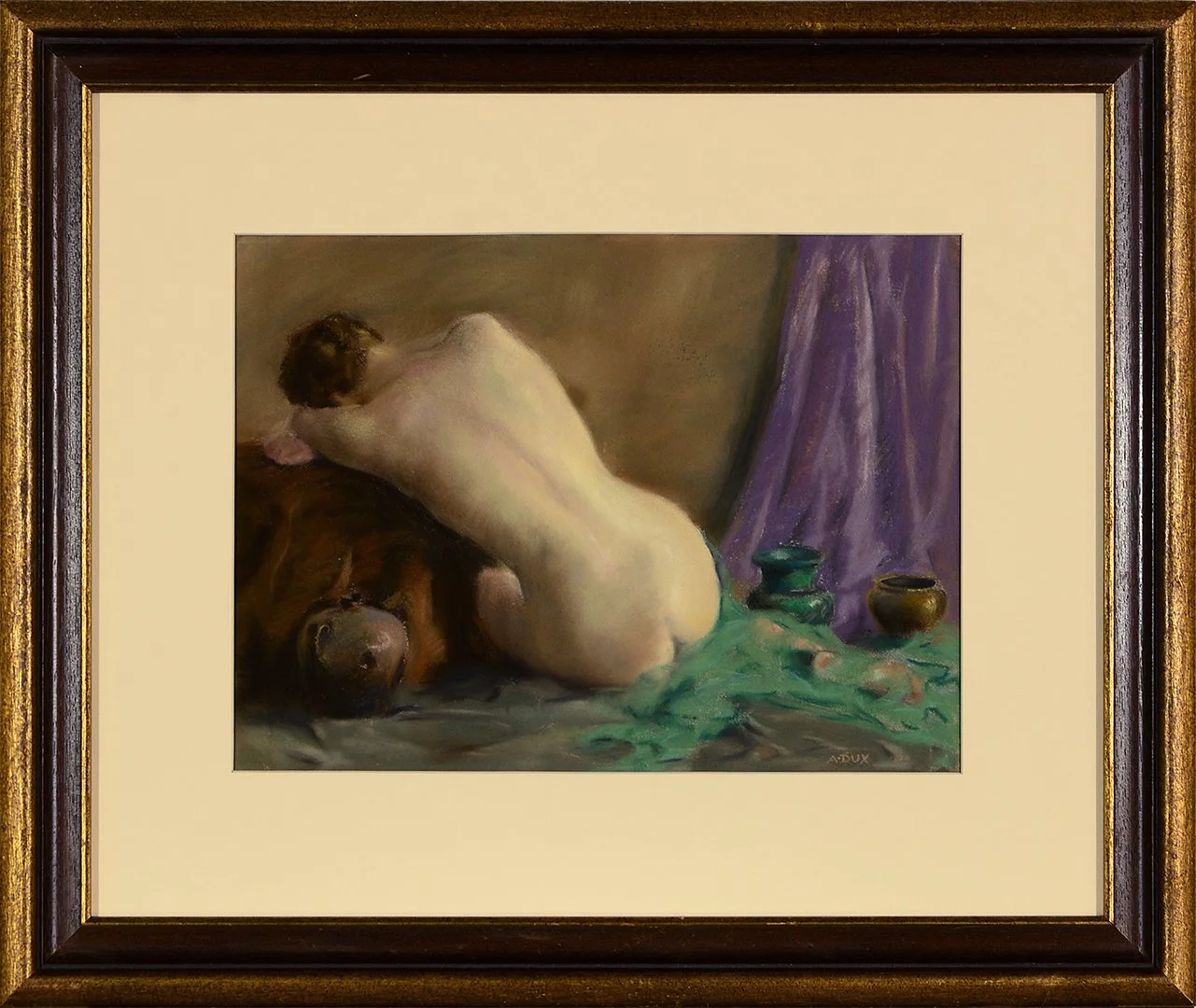
Alexander Dux
Porcelain Nude
Pastel on Paper
12 x 16 inches
21 1/2 x 25 1/2 inches in the frame
Signed Lower Right
ID: DH4899
The following biography was researched, compiled, and written by Geoffrey K. Fleming, Executive Director, Reading Public Museum, Reading, PA.
ALEXANDER (SANDOR) DUX (April 1, 1898 – December 1971)
Figurative and landscape painter, pastelist and commercial artist. Born “Sandor Dux” in the Austro-Hungarian Empire, the son of Fannie (b. 1865) and Henry Dux (1867 – 1936). The family first resided downtown along East 13th Street. Today Alexander Dux is remembered as the designer of a number of well-known and recognizable travel posters during the Works Progress Administration (W.P.A.) period.
The Dux family were Jewish, and decided to emigrate to America for better opportunities, arriving in New York City in 1910 aboard the now famous passenger ship, S.S. Carpathia (which became famous 2 years later for the aid they rendered in rescuing passengers from the R.M.S. Titanic disaster). Dux himself became a naturalized citizen in 1925. He appears to have been first employed as a library clerk at the main branch of the New York Public Library along 5th Avenue.
During this period, he studied art at the National Academy of Design in New York. It was there that in 1921 he received an honorable mention in the annual Chaloner Prize competition. He joined the recently formed Society of Independent Artists and participated in their 1925 annual exhibition. By 1930, Dux had married and moved to Van Cortlandt Park South in the Bronx, where he was employed by an advertising company as a commercial artist. He ended up marrying two sisters, Anna Maram (1896 – 1935) and Elizabeth Maram (1898 – 1973).
Like many artists during the depression, Dux was associated with the Federal Art Program and oversaw the design of several pieces produced under their auspices. These included the 1936 design for the 1937 ‘See America’ travel poster depicting the Carlsbad Caverns, which was created for the United States Travel Bureau. According to rethinkingwpa.com, this series of posters: “…had a social purpose that ties back to American artists searching for their identity in trying to relate their art to issues relevant to the problems that affected them. In promoting destinations that represented the nation’s past and present, the collection exemplifies the Depression era search for a usable past that could ameliorate social tensions and unite Americans by recovering and affirming national values.”
Dux also participated in the creation of the official Works Progress Administration Federal Arts Project 1939 calendar. By 1940 he was listed in the census without any information regarding employment, though alternative records noted he was “self” employed, while his wife was listed as working as a public school teacher. As the 1950s’ began, Dux and his family remained in the Bronx where he was once again listed as being employed as a commercial artist.
Alexander (Sandor) Dux died in White Plains, New York in December of 1971 at the age of seventy-three years. It is unclear from where his services were held nor where he was eventually interred. His widow, Elizabeth, would commit suicide two years later.
Dux’s poster design for the Carlsbad Caverns is widely reproduced today and has been featured or discussed in numerous publications over the years, including Francis V. O’Connor’s Art for the Millions: Essays from the 1930s by Artists and Administrators of the WPA Federal Art Project (1973). One of the most recent was Douglas Leen’s book Ranger of the Lost Art: Rediscovering the WPA Poster Art (2023).
Though there are undoubtedly other exhibitions in which Dux participated, those presently known include the following: National Academy Design, New York, NY, c. 1920-1924; The Society of Independent Artists, New York, NY, 1925.
Dux’s works are currently known to be in the collection of the following public institutions: Library of Congress, Washington, DC; National Archives, Washington, DC; Philadelphia Museum of Art, Philadelphia, PA. His works primarily reside in many private collections throughout the United States.


Quisque iaculis facilisis lacinia. Mauris euismod pellentesque tellus sit amet mollis.