Henry Ward Ranger
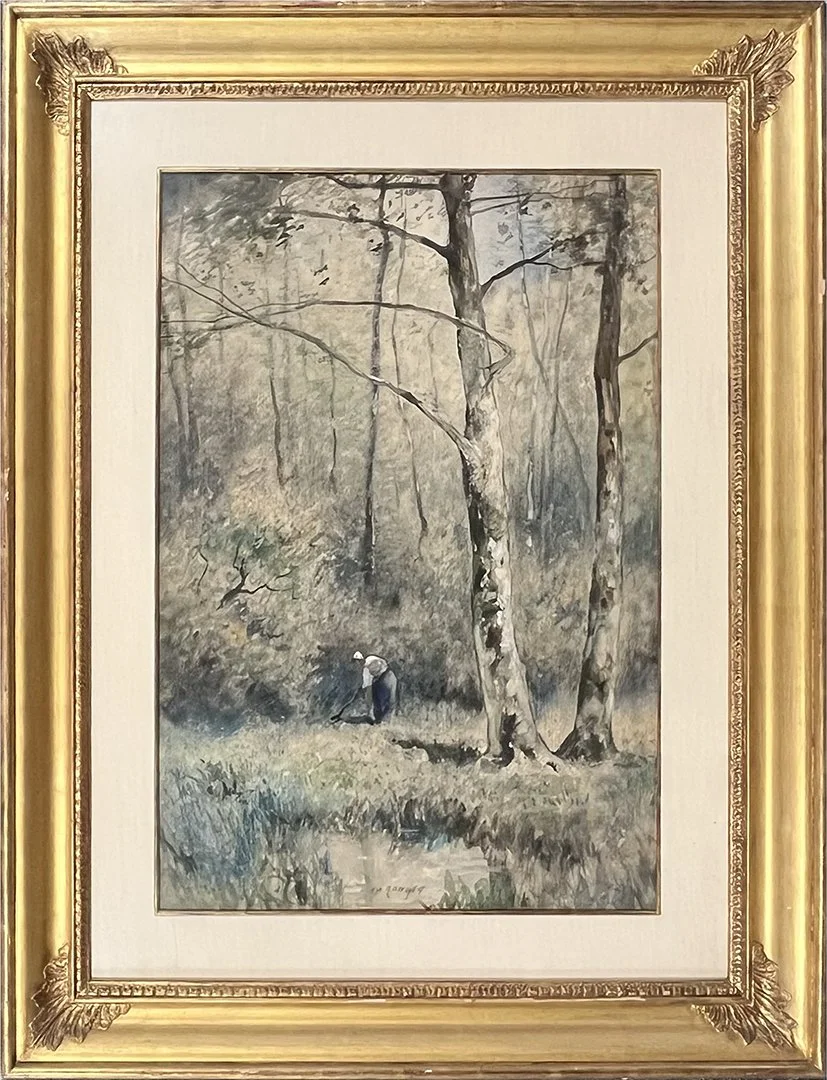
Henry Ward Ranger
Woman Working in the Forest
Watercolor
28 x 19 inches
40 x 30 3/4 inches in the frame
Signed Lower Center
ID: DH5045
Henry Ward Ranger (American, 1858–1916) was a pivotal figure in American Tonalism and a founding force behind the Old Lyme, Connecticut art colony in 1899. Born in Geneseo and raised in Syracuse, New York, he studied at Syracuse University’s College of Fine Arts, where his father taught, and later developed his artistic direction through exposure to French Barbizon painting and the Hague School in Holland. Deeply influenced by their atmospheric realism and subdued palettes, Ranger became known for his moody forest interiors and tonal landscapes, often sketching outdoors and completing his canvases in the studio. By the 1890s, he was exhibiting prominently in New York, including a 1892 solo show at Knoedler Galleries.
Ranger emerged as a leader at Old Lyme, shaping it into what was described as an American counterpart to Barbizon. However, with the arrival of Childe Hassam in 1903 and the growing dominance of Impressionism, he distanced himself from the colony, relocating to Noank, Connecticut in 1905. Active in New York’s art circles, he lectured, wrote on art, and was a member of the National Academy of Design and the National Arts Club. Upon his death in 1916, he bequeathed his estate to the National Academy to establish the Ranger Fund, supporting the work of mature American artists.
Quisque iaculis facilisis lacinia. Mauris euismod pellentesque tellus sit amet mollis.